
Event mechanics & config
The mechanic document first, then the config that puts it live: reward tables, unlock rules, windows and the numbers ops needs to run it without me.
All titles
Game Designer · Product Manager · Ho Chi Minh City
Seven years across mobile, indie and blockchain titles — five shipped games, from idle RPG and auto-battler systems to NFT economies. I design the loops players repeat and the numbers underneath them, own the design documentation set, and run the product from concept through launch and live operations.
Scope of responsibility
The honest version of a credits list: where I was the person accountable for the work, where I shared it with a co-designer or a partner studio, and where it simply wasn't part of my role.
| Workstream | Hải Tặc Loạn Đấu 2026 |
Heroes Awaken 2023 |
Heroes & Empires 2021 |
Cyborg Heroes collab |
Heroes Defense spin-off |
|---|---|---|---|---|---|
| Event mechanics & config | |||||
| New hero pipeline (docs + setup) | |||||
| PvP features | |||||
| IAP packs & monetization | |||||
| Economy balancing & rebalance | |||||
| New game modes & mechanics | |||||
| Design documentation set | |||||
| Roadmap, release & builds | |||||
| Tokenomics & whitepaper |
Deliverables
A system isn't designed until someone else can build it without asking me a question. These are the real files a title runs on — the index every discipline works from, and the library behind it.
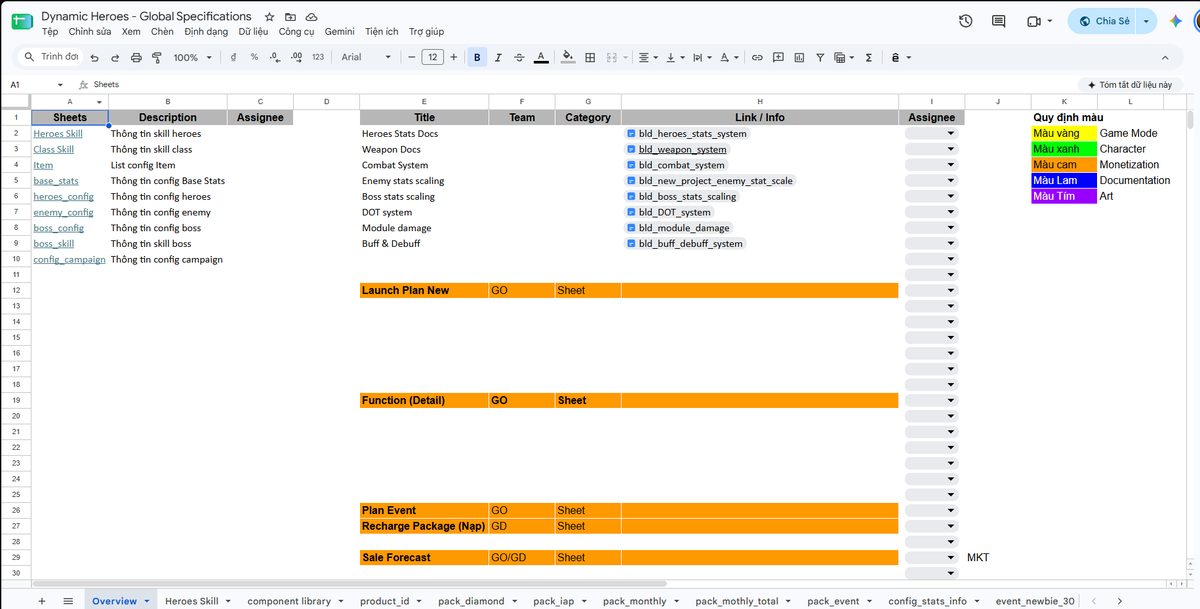
One sheet that tells the whole team where everything lives: hero and class skills, item, base-stat, enemy, boss and campaign configs on the left; combat, DOT, module-damage and buff/debuff system docs on the right. Colour-coded by discipline — game mode, character, monetization, documentation, art — with an assignee per row, so the same file carries the launch plan, event plan, recharge packages and sales forecast.
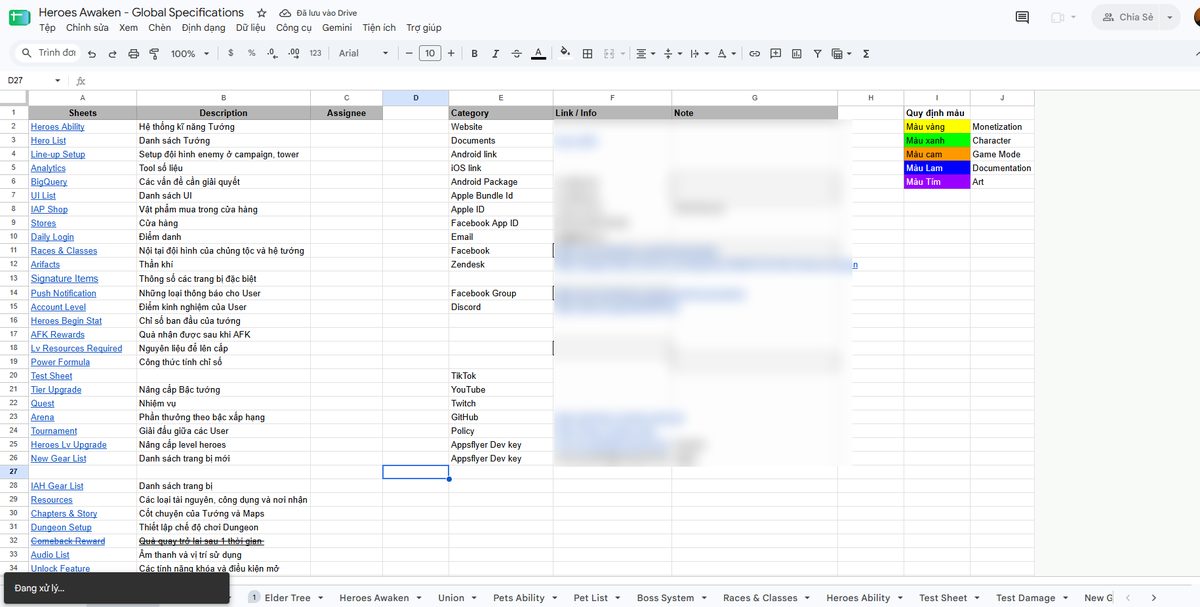
Thirty-plus linked sheets: hero ability and hero list, line-up setup for campaign and tower, races and classes, artifacts and signature items, AFK rewards, level-up resource costs, the power formula, tier upgrade, quest, arena, tournament, gear lists, chapters and story, dungeon setup, IAP shop, daily login, push notifications and the UI list.
Store IDs and integration keys blurred.
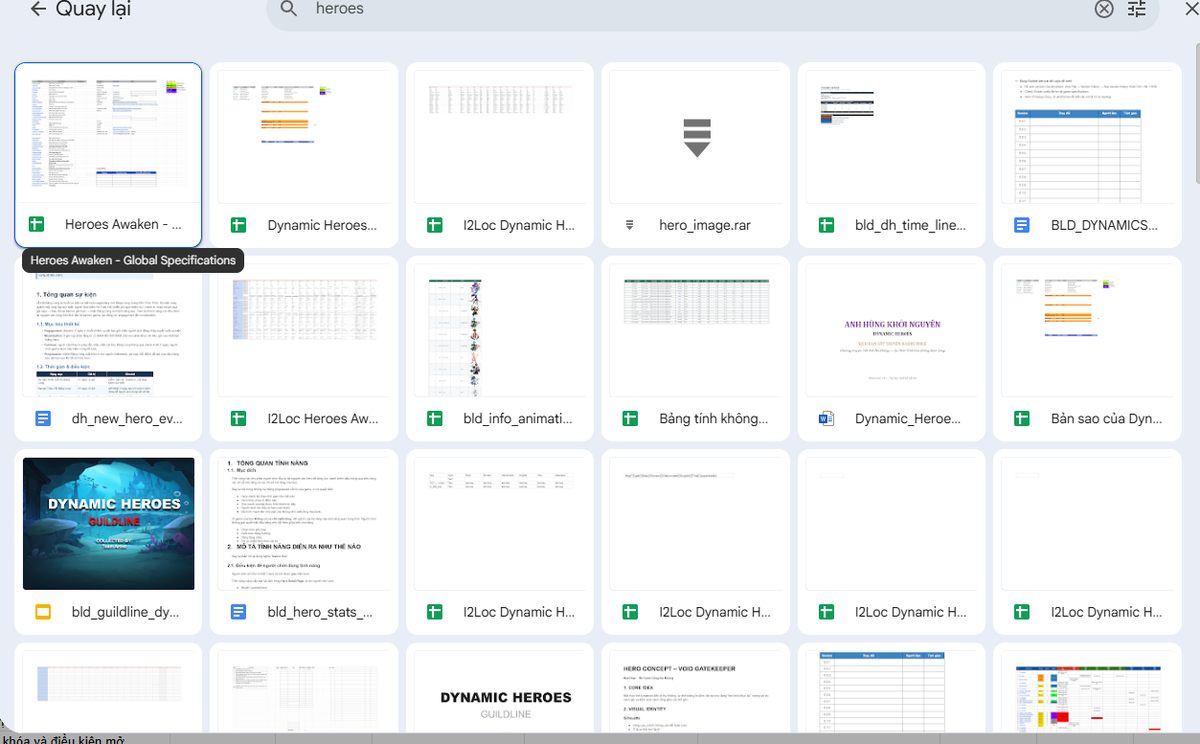
Guild guidelines, hero concept sheets, new-hero event specs, production timelines, localisation files and stat tables — one library per title, kept current so art, engineering and QA are always reading the same version of the design.
Practice
Hero collection, formation and progression — the part players touch every session. I define the loop, the power curve behind it and the modes that consume that power.
Every currency has a source, a sink and a reason to exist. I build the spreadsheet that proves a free-to-play player can keep going and a paying one still feels the purchase.
A shipped game is a schedule. I own the roadmap and backlog, run sprints with art, engineering and QA, and keep the content calendar full after launch.
Recurring work
A live game is not one design problem solved once — it is the same six streams turning over, build after build. This is the work I have repeated across five titles, and where the craft actually accumulates.
The mechanic document first, then the config that puts it live: reward tables, unlock rules, windows and the numbers ops needs to run it without me.
All titles
Docs and setup for each new hero — role and faction fit, base stats and growth, skill kit, gacha placement — so a release slots into the existing power curve instead of breaking it.
All titles
Match rules, matchmaking bands, season and ranking structure, reward tiers — and the counterplay that keeps a formation choice meaningful against another player.
4 titles
Building out the pack line-up — daily, growth, event and bundle tiers at different price points — plus the bug pass that follows every build before it goes out.
4 titles
When live data says the curve drifted — currency piling up, a pack that stopped converting, a mode nobody enters — I re-tune faucets, sinks and prices and re-issue the sheet.
All titles
A mode is a sink with a story attached. Mechanic doc, entry cost, difficulty curve, reward table, and where it sits against the modes already competing for the same session.
All titles
Process
The same route every time, whether it is a new hero, an event or a whole game mode. Steps 3 to 7 keep turning long after the feature is "done" — that is what live operation actually means.
What the mode has to fix, what competitors already solved, and where the session currently leaks players.
Goal, rules, entry points, states and edge cases — written so engineering, art and QA each find their own section.
Costs, reward tables, drop rates and growth curves, on formulas rather than typed values.
UX flow with art, spec review with engineering, and the version build itself.
Verify against the doc, work the bug list, re-cut the build until it matches the spec.
Event windows, banner schedule and pack line-up loaded into the live-ops calendar.
Watch what players actually do, then re-tune faucets, sinks and prices and re-issue the sheet.
A rebalance is a config change, not a rewrite. That is the whole point of putting the numbers on formulas in step 3.
A design that can only be changed by rewriting the document dies at the first live surprise. Mine are built to be re-tuned by whoever is on shift.
Selected work · 2021 → 2026
Idle AFK hero-collection RPG · iOS & Android
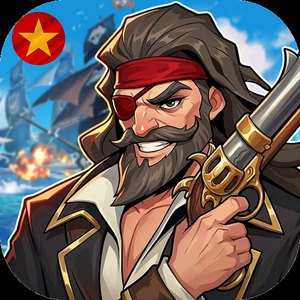
A pirate-themed idle AFK RPG built for the Vietnamese mobile market. I joined as product owner of the title: one person accountable for what ships, when it ships and whether the numbers underneath it hold together.
An idle game pays the player while they are away, so the sinks have to be honest — otherwise the currency piles up, the summon banner stops mattering and progression flattens. Six modes exist partly to give that income somewhere to go, each with a different entry cost and a different reason to build a second lineup.
Free-to-play balance is the width of the dashed return path: wide enough that a non-paying player keeps climbing, tight enough that summon banners stay the fastest route to roster depth.
Idle RPG × auto-battler · Mobile
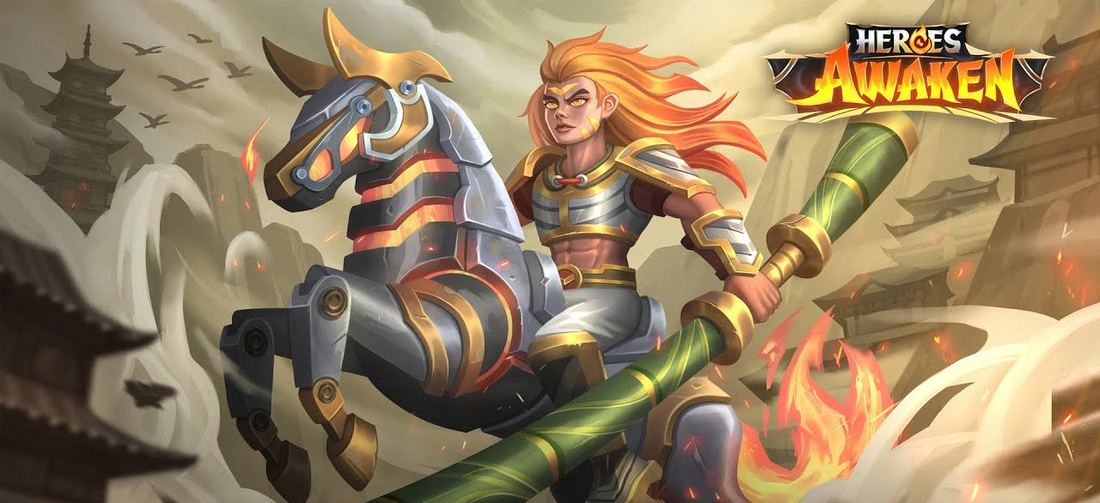
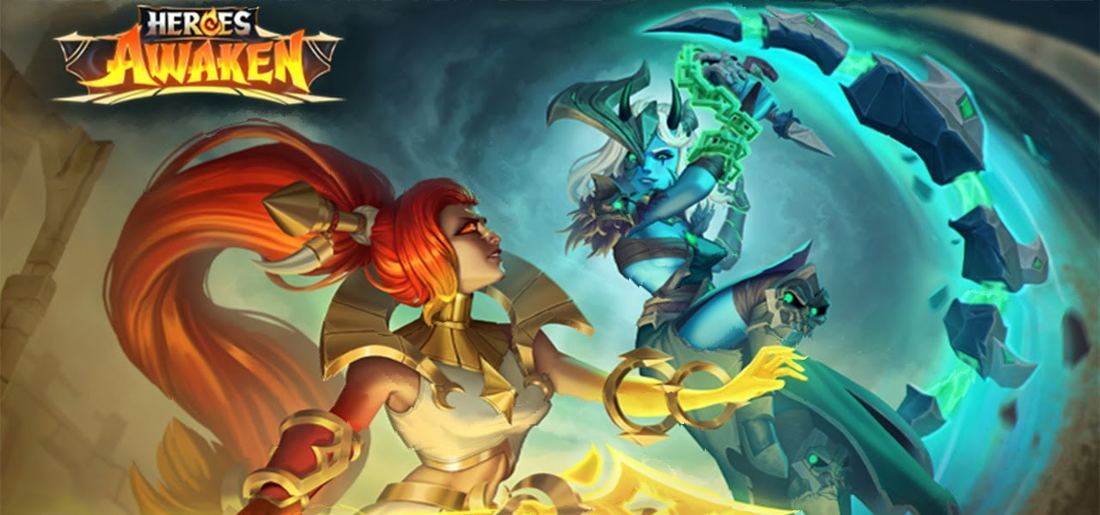
Heroes Awaken · key art · Imba Games
Imba Games' flagship idle RPG, crossing idle progression with auto-battler combat. I was responsible for the main production and the credited author of the design set — the person the rest of the team read to know what the game was.
A roster that size is not seventy balance problems, it is one: every hero has to be worth pulling without any hero being mandatory. Balancing there means tuning against the modes — a hero that is mediocre in Campaign has to have a tower, an arena or a synergy where it is the answer.
Winner across five categories at the 2024 Vietnamese Game Awards — indie game, storyline, mobile game, gameplay and graphic design.
NFT strategy RPG on BSC · Mobile & PC
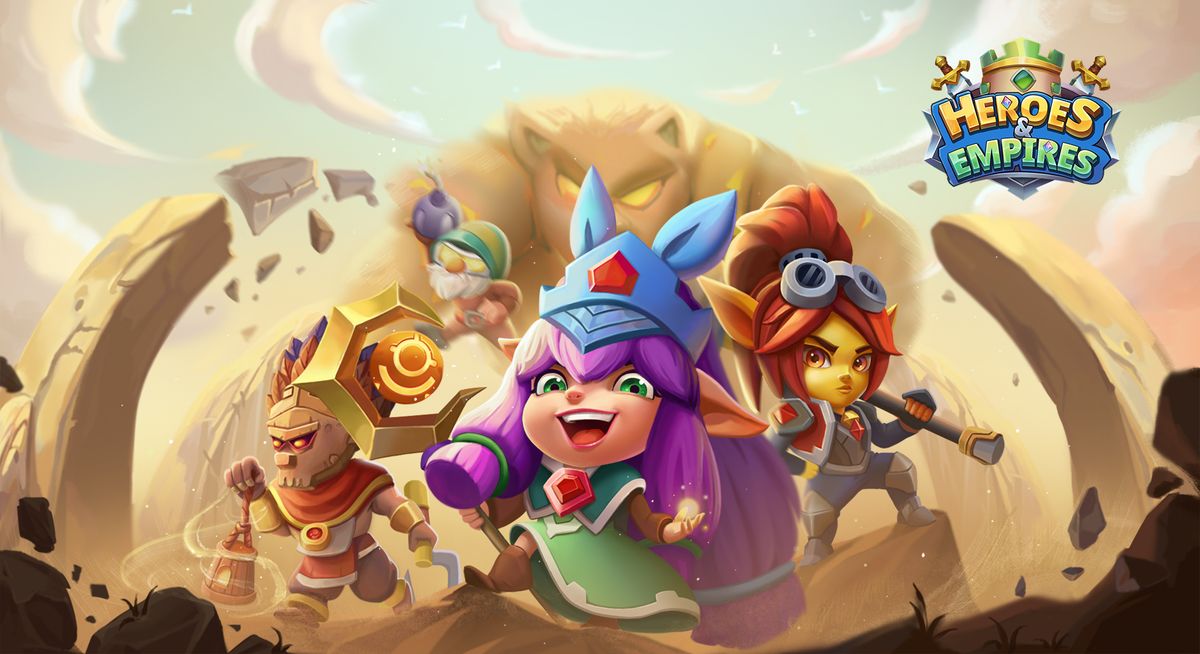
Heroes & Empires · key art · CryptoViet Labs × Imba Games
A co-production between CryptoViet Labs and Imba Games: an idle-RPG and auto-chess hybrid where the heroes are NFTs on Binance Smart Chain. The brief had two economies to satisfy at once — the in-game one and the token one — and they pull in opposite directions.
Revenue within the first month of launch, and a place among the world's top 10 NFT games at the time.
Backers included DAO Maker, Icetea Labs, X21 Digital, Magnus Capital
Title delisted since; the raise, token and press record remain public
One billion HE created at genesis for the October 2021 IDO, with only 8% circulating on day one and everything else on a vesting schedule — the supply discipline that stops a play-to-earn economy from eating itself in week two.
The design question on a play-to-earn title is not how players earn, it is what makes them stop selling. Fusion is the answer: the only route to a higher tier consumes heroes, so demand and the burn sit on the same button.
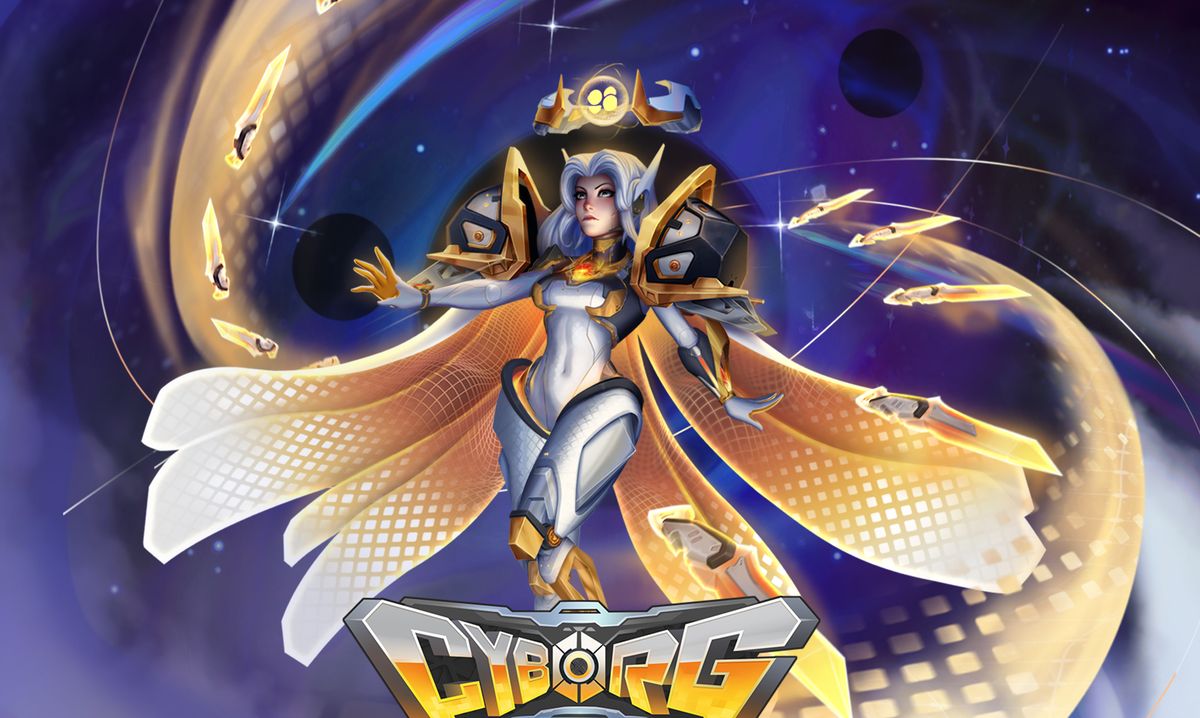
Coin98 × Heroes Awaken collaboration · Game Designer
A collaboration build is a constraint exercise: keep the systems the live game already validated, change everything the player reads as identity, and ship it on the partner's schedule.
Heroes Defense: Apex Guardians · Imba Games · Game Designer
VNG · Middle Game Designer, 2020—2021
Casual games on a chat platform are a different design problem to an idle RPG: the session is two minutes long, the audience is everyone, and the only tutorial you get is the first screen.
Shape, not values. Elites step the pressure up, every boss peak is followed by a deliberate drop, and the back half sits above the front half — so the same hero build feels different at wave 18 than it did at wave 4. Tuning a defense stage is tuning this line.
2018 → present
Product Manager & Game Designer
Product owner of Hải Tặc Loạn Đấu: Idle AFK — roadmap, systems design, economy and release management, running sprints across art, engineering and QA.
Game Designer · 4 shipped titles
Heroes Awaken, Heroes & Empires, Cyborg Heroes and Heroes Defense. Main production responsibility on the flagship title, economy and balancing across the portfolio, and the design documentation set.
Middle Game Designer, Zalo game platform
Wrote the design documentation behind two products on the Zalo Game Center — a billiards game and Cờ Tỷ Phú, a property-trading board game — sketched UI/UX for new features, ran in-game events, and tracked and reported the games' performance metrics.
Game Designer · Product operations collaborator
Created 3D models for games and supported product operations on live titles.
Game Design · graded Very Good
Formal game design training — the grounding for the documentation and systems practice the rest of this page is built on.
Vietnamese Game Awards 2024
All five for Heroes Awaken, where I was the credited author of the design set and responsible for the main production.
Separately, Heroes & Empires reached $500K revenue in its first month and was listed among the world's top 10 NFT games — the economy and tokenomics work I did on that title is the closest thing I have to a stress test.
Tools, platforms, languages